Peasant autonomy and the land
Doctor ZhivagoPeasant autonomy and the land is the rural hope for self-sufficiency that the revolution awakens but fails to fulfill. The novel gives that hope political force by setting it against the new state’s demands, and material weight through the food, fuel, housing, and work by which ordinary people try to live.
The peasant’s desired independence
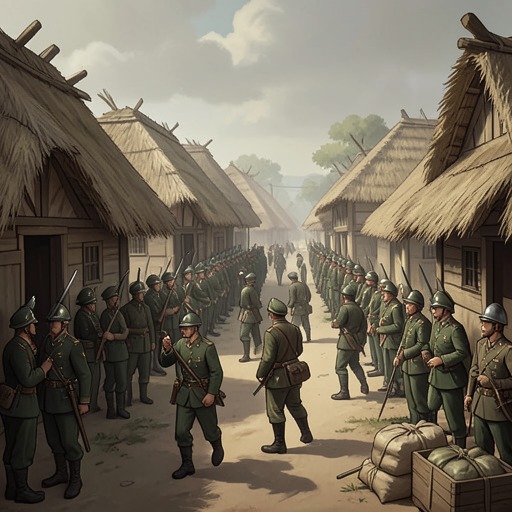
At dinner, the co-operativist Kostoried challenges Yurii Andreievich’s inference that intact station trees and fences, busy markets, and well-fed-looking travelers prove that the countryside is flourishing. Beyond the railway, he says, peasant rebellions are widespread, directed against whichever side holds power, Red or White. Their resistance is not evidence that peasants do not know what they want. Kostoried argues that they know it better than their urban observers: they want to live on their own land, by the work of their own hands, in complete independence and without obligations to anyone.
The revolution has therefore raised an expectation only to frustrate it. The peasant, in Kostoried’s account, believed that a century-old dream was coming true; instead, the former state’s oppression has been replaced by the harsher yoke of a revolutionary superstate. The unrest of the villages follows from that reversal. Autonomy is not simply a partisan slogan in this exchange: it is a demand for control over land and labor, and for release from both old and new forms of authority.
The city’s fragile provisioning
The novel sets this account beside urban scarcity, where food and fuel are acquired through improvised labor and exchange. For a long period, many people subsist on thin millet boiled in water, soup made from herring heads, and kasha from unground wheat or rye. A friend teaches Antonina Alexandrovna to bake bread in an improvised Dutch oven; she hopes to sell enough to cover the cost of heating the tile stove, but the plan fails, and the family must return to a smoky iron stove that gives little warmth.
When only two logs remain, Antonina goes out looking for fuel. She finds a young peasant carrying birch logs on a small sleigh and accepts wood that is freshly cut and poor for burning because there is no better choice. In exchange, he takes her small mirrored wardrobe, which he plans to give his bride. Their possible future trade in potatoes leads him to ask about the piano as well. The transaction makes domestic goods convertible into fuel and food, while showing how scarcity reaches into the household’s most personal possessions.
A different route to provisions briefly restores the Zhivagos’ sense of usefulness. After Alexander Alexandrovich consults for the Higher Economic Council and Yurii Andreievich treats a dangerously ill government member, they receive credit slips for goods at a distribution center in an old army warehouse near the Simonov Monastery. In its vaulted cellar, an attendant fills their pillowcases with flour, cereals, macaroni, sugar, suet, soap, matches, and Caucasian cheese. They hurry away with the bundles in sacks; their elation comes not only from the food but from feeling that their work has made them useful and earned Tonia’s gratitude.
Land, housing, and revolutionary administration
The struggle over independence also appears in the conversion of homes into institutional space. The Zhivagos give part of their ground floor to the Agricultural Academy, which moves in its libraries, herbariums, and seed specimens. Tonia explains that the family no longer calls the rooms “rooms” but “living space”: the change in vocabulary accompanies a change in who may occupy a household and for what purpose.
At a meeting in a large house, a speaker proposes taking over the building as a district soviet hostel for visiting delegates and naming it the Tiverzin Hostel. Residents would have a year’s notice; working people would be rehoused, while others would have to find accommodation themselves. When occupants protest that they are all workers, the speaker dismisses the objection and insists that the eviction of a particular resident is not a question of nationality. The scene shows how political categories and administrative decisions can override the inhabitants’ own claims to a place.
A household made provisional
Later, Larisa Feodorovna explains that she and Katenka were assigned part of someone else’s house after the school building was taken over by the Town Housing Department. The owners have left their furniture behind; unwilling to live among another family’s possessions, she stores it in two rooms and whitewashes the windows. To reach her own room, visitors pass through dark, crowded rooms like a maze. Even a domestic visit follows a route shaped by displacement and institutional reassignment.
In the country, Yurii and Lara break into the padlocked Mikulitsyn house and find the study unusually tidy, as if someone had lived there recently. They do not discover who; they suppose a fugitive officer may have been the intruder and make no attempt to resolve the mystery. Their own arrival turns an uncertain, possibly temporary refuge into a place to inhabit. After Lara cooks potato soup and roast mutton with potatoes, Katenka eats her fill and falls asleep in her mother’s shawl. Yet Lara worries that their labor may be for nothing: they have entered another person’s house and are acting out a life that feels like a stage set. Shelter offers togetherness, but does not restore the security of possession.
Political idea grounded in daily life
Across these episodes, autonomy is measured less by declarations than by access to land, warmth, food, and a home that can be called one’s own. The city’s rationed goods, the exchange of a wardrobe for firewood, and the reassignment of rooms expose the material conditions that make independence difficult. Against them stands the peasant ideal Kostoried describes: work and land joined without an authority claiming the right to direct either. The novel’s scenes do not present that ideal as achieved; they reveal the distance between the promise of liberation and the obligations imposed in its name.